Hidden Skills: Why Every Brain in Your Classroom Works Differently
Look around any classroom and you’ll see it straight away: no two children learn, behave or respond in quite the same way. One child finishes a task in minutes and moves immediately on to the next thing. Another stares at the same page for ten minutes, not because they don’t understand it, but because they can’t find the first step. A third seems to be listening perfectly well, then has no idea what to do when the instructions stop.
It’s tempting to read these differences as effort, attitude or ability. Often, they’re none of these things. They’re executive function and understanding it is one of the most useful shifts an educator can make.
What executive function actually is
Executive function is the set of mental skills we all use to manage ourselves and get things done. At Connections in Mind, we work with eleven core executive function skills: task initiation, response inhibition, flexibility, organisation, goal-directed persistence, metacognition, sustained attention, planning and prioritisation, emotional regulation, working memory, and time management.
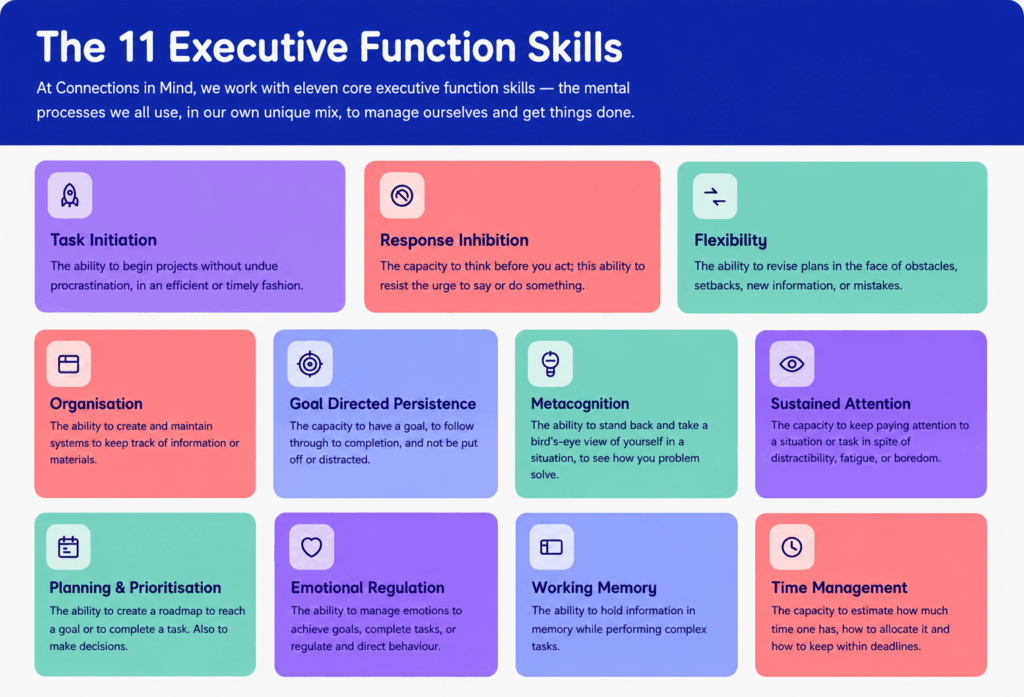
In practice, these are the skills that let a pupil start a task without being nudged twice, resist blurting something out, change course when a plan falls apart, keep their books and materials in order, see a project through to the end, stand back and notice how they’re doing, hold their focus through something dull or difficult, map out the steps to a goal, manage frustration or excitement, hold instructions in mind long enough to act on them, and judge how long something will actually take.
These skills sit behind almost everything we ask pupils to do in a school day: sitting still and listening, starting a task without being told twice, holding instructions in mind long enough to follow them, moving from one lesson to the next, managing frustration when work is hard. None of this is really about knowledge or intelligence. It’s about the invisible machinery that makes knowledge usable.
And that machinery looks different in every single pupil.
Why every brain is wired differently
The human brain contains around 90 billion neurons, joined together in a network of trillions of connections. From birth, genetics and experience shape how those connections form, the people around us, the environments we spend time in and what we learn all leave their mark. The result is that no two brains ever develop in exactly the same way, not even in identical twins.
This natural variation between brains is called neurodiversity. Some pupils are neurotypical, meaning their brains work in ways broadly aligned with what society expects. Others are neurodivergent, autistic pupils, or those with ADHD, dyslexia or dyspraxia, for example. Neither is better or worse. Different brains bring different strengths, different needs and different ways of experiencing a classroom.
Executive function is one of the clearest places this variation shows up, and it rarely announces itself as a “learning difficulty.” More often it hides in plain sight, as a hidden skill or a hidden struggle, easy to misread as something else entirely.
The hidden skill educators often miss
A pupil can know exactly what they’re supposed to do and still find it genuinely hard to start, to sequence the steps, or to keep going once the first burst of enthusiasm fades. This is where “hidden skills” cuts both ways. Sometimes it’s a hidden strength, a pupil who has quietly built brilliant coping strategies to manage a challenge no one else has noticed. Sometimes it’s a hidden barrier, a capable pupil whose executive function struggles are mistaken for laziness, defiance or not trying hard enough.
It’s also worth remembering that executive function isn’t fixed from moment to moment. These skills become harder to access when a pupil is stressed, tired, hungry, lonely or bored, which means the same child can look completely different on a good day versus a hard one. A pupil who manages beautifully on Monday morning might completely fall apart by Friday afternoon, and that’s not inconsistency or manipulation. It’s a nervous system running on empty.
Shifting the question
The most powerful tool here isn’t a strategy or a resource, it’s a change in the question we ask ourselves. Instead of “Why are they doing that?”, educators can start asking, “What is this telling me about how their brain works, and what do they need right now?”
That small reframe changes everything downstream: how instructions are given, how transitions are managed, how a meltdown or a shutdown is responded to, how much support is offered before a task begins rather than after it’s already gone wrong. It moves us away from judging behaviour and towards understanding the brain producing it.
When we build classrooms and staffrooms around this understanding, we create places where pupils don’t have to mask, exhaust themselves or feel constantly “not enough” just to get through the day. Everyone, neurotypical and neurodivergent alike, benefits from environments that expect difference rather than punishing it.
Bringing this into practice
Recognising executive function differences is the first step. Turning that recognition into everyday classroom practice, realistic expectations, scaffolded routines, language that supports rather than shames, is where the real change happens for pupils and for the adults supporting them.
That’s exactly the space Connections in Mind works in: helping schools and educators understand neurodiversity and executive function, and turning that understanding into practical, compassionate approaches that work in real classrooms. To help you put it into practice, we’ve put together a range of free and paid resources for schools, students and families, all available on our resources hub, including:
- Everyone’s Brain Is Different, the short film this post is based on, free to watch and share.
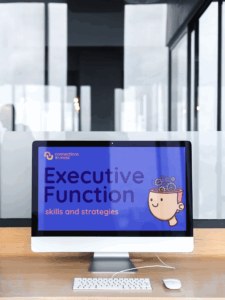
- PowerPoint Presentation: Executive Function Skills and Strategies, a ready-made training deck you can use for staff INSET days or parent information evenings, covering the 11 executive function skills and practical strategies to support them.
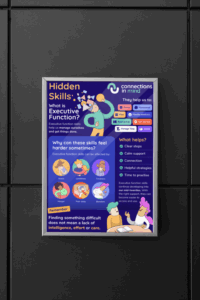
- “What is Executive Function?” flyer, a clear, quick-read introduction to executive function, perfect for staffrooms, parent packs or newsletters.
- Executive Function Fact Sheet for Students and Parents a jargon-free overview that helps students and parents get on the same page, opening the door to more supportive conversations at home and at school.
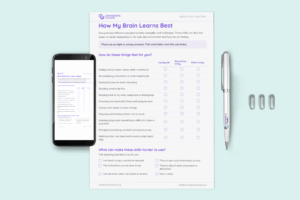
- Self-assessment questionnaire, a downloadable tool that helps students explore their own strengths and challenges across the 11 executive function skills, building self-awareness and giving staff a natural starting point for conversations.
- Poster pack, eye-catching, downloadable posters for classrooms and corridors, keeping the language of executive function visible and normalised around your school.
Checkout our new training for 2026