When Everything Feels Too Much: Rethinking Burnout in Schools
Over the past few years, we’ve been hearing something more and more in schools, from students, teachers, and parents alike:
Everything feels like too much.
Students are tired. They are busy. They are juggling school, homework, revision, sport, music, social lives, online lives, friendships, family expectations, and thinking about their future from a very young age.
At the same time, their worlds are always “on”. Messages, notifications, comparison, expectations, it rarely stops. There is very little space for their brains and bodies to fully switch off and reset.
The statistics suggest this isn’t just a feeling. Around 1 in 5 young people in England aged 8 to 25 now has a probable mental health disorder, and around 20% of pupils are persistently absent from school, missing at least 10% of sessions. Children with mental health difficulties are significantly more likely to miss school.(gov.uk)
But behind the statistics are real young people who are trying to keep up in a world that is asking a lot of them.
So when we talk about burnout in schools, we are not talking about a small group of students. We are talking about something that is affecting a large proportion of young people.
The Body Budget
One idea that really helped shape our thinking comes from Lisa Feldman Barrett’s book Seven and a Half Lessons About the Brain, a really accessible read for teachers and parents.
She describes the brain and body as constantly managing a “body budget”, balancing resources like sleep, food, movement, stress, emotions, and social connection.
When this system is in balance, we can think clearly, manage emotions, make decisions, and cope with challenges. When it is out of balance for too long, everything starts to feel harder.
In simple terms, when our body budget is low, everything feels harder.
This gave us a really helpful way to talk about burnout with students, because burnout is not really about being busy. Burnout is about being out of balance for too long.
The Real Issue Is Executive Function Capacity
In schools, we often talk about students needing to be more organised, more focused, better at time management, better at starting work, better at finishing work, better at managing emotions, and better at making decisions.
All of these things are executive function skills.
But executive function depends on capacity and that capacity is shaped by our body budget.
When our body and brain are out of balance, our body budget is low, and we have limited capacity for executive function.
This means students may:
- Find it harder to focus
- Procrastinate more
- Forget things
- Find small problems overwhelming
- Become more emotional
- Avoid work
- Seem unmotivated
- Struggle to get started
- Struggle to finish tasks
Often, these are capacity problems, not effort problems.
So if we want students to be more organised, more independent, more resilient, and more successful, we cannot just teach executive function skills. We also have to help students protect and build their capacity.
Everyone Is Different (Including Neurodivergent Students)
One of the most important parts of this conversation is recognising that everyone’s body budget is different.
Some people need more sleep than others.
Some people need more quiet time.
Some people need more movement.
Some people need more social time.
Some people find school environments very draining.
Some people find social situations very draining.
This is particularly important for neurodivergent students, who often use more capacity to manage attention, organisation, sensory environments, emotional regulation, and social situations. This means they can reach capacity more quickly and are often more vulnerable to burnout.
Research shows that neurodivergent children experience higher rates of mental health difficulties, with studies suggesting that around 70% of autistic young people have at least one mental health condition which makes conversations about balance, boundaries, and burnout even more important. (england.nhs.uk)
So this is not about telling all students to do the same things.
This is about helping students understand their own capacity and their own balance.
We Know Simple Visuals on a Poster Helps Ideas Stick
We know that metaphors and visuals help ideas stick, and we also wanted something that would be accessible to as many learners as possible.
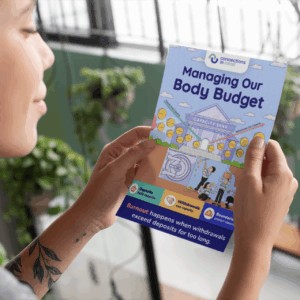
So we created a simple model using a capacity bank concept:
- Deposits build capacity
- Withdrawals use capacity
- Boundaries protect capacity
- Burnout happens when withdrawals exceed deposits for too long
We turned this into a visual poster so students could actually see the idea, not just hear about it. The aim was to create something simple enough that students could remember it and apply it to their own lives and decisions.
We Know Educators Don’t Have Time to Build Presentations From Scratch
We know that educators are incredibly busy, and even when ideas like this resonate, there is rarely time to turn them into a clear, school-friendly presentation.
So we created a short, ready-to-use presentation that introduces the Body Budget in a simple, structured way. It can be used in an assembly or tutor session to give school community members a shared understanding of deposits, withdrawals, boundaries, balance, and burnout.
The aim is not to deliver a one-off talk, but to give school community members, a framework they can keep coming back to:
- Why am I finding everything harder this week?
- Why can’t I focus?
- Why do I feel overwhelmed?
- Why am I procrastinating?
- Why am I so tired?
- Do I need more deposits?
- Are my withdrawals too high?
- Do I need stronger boundaries?
It gives schools a starting point without adding to workload.
We Know Clear, Accessible Video Explanations Make a Difference
We also know that short, clear explanations can really help people make sense of what they are experiencing.
As part of this, we’ve created a short video — one of our NeuroInsight modules — where we explain the neuroscience of burnout in a clear and accessible way.
We Know How Important It Is to Align Language Across Communities through our info sheet.
We also know how powerful it is when a whole school shares the same language. Without that, students can receive very different messages from different adults and their peers.
So we created a simple information sheet that can be shared with students, staff, and parents. It explains the key ideas clearly and supports consistent conversations across the school community.
This shifts the conversation from:
“You just need to try harder.”
To:
“Let’s look at your capacity, is your body budget in balance.”
We Know Reflection Needs to Be Structured, Not Just Discussed
We also know that simply talking about these ideas is not always enough. Students need support to reflect on their own lives in a structured way.
So we created a printable worksheet that helps students:
- Identify their own deposits
- Recognise their main withdrawals
- Notice early signs of being out of balance
- Reflect on their boundaries
This gives students a chance to pause and think about their own body budget and how to manage it. Educators can use this sheet to scaffold 1:1 or small group pastoral conversations.
Helping the Whole School Community Flourish, Not Burn Out
This is a common challenge in schools, not just for students, but for the whole community. Teacher burnout is a very real issue, and many adults in schools are also working with high demands and limited capacity.
The body budget is not just a model for students.
It is a model for all of us.
An executive function approach offers a shared way of understanding this. When we talk about deposits, withdrawals, boundaries, and balance, we are not just supporting students, we are supporting everyone.
By helping both students and adults to understand their capacity, notice when they are out of balance, and protect it, we create environments where people can work hard, take on challenges, and thrive, without burning out.
We hope you find these resources helpful across your whole school community.
We would love to see how you are using them in your setting; please do share any photos or examples of the resources in action.
Related Resources
-
Coaches and Therapists - CPD
Why Is Maintaining Boundaries So Hard?
£50.00Original price was: £50.00.£25.00Current price is: £25.00. Add to basket -
Coaches and Therapists - Resources
Neuro-Insight Module – Burnout, Balance & the Body Budget
£15.00 Add to basket