Brain Hub

Search Resources

Judgement & Executive Function: What We Don’t See

13 min read
•
Executive function insights

Judgement & Executive Function: What We Don’t See

“Why haven’t you started yet?”
“You need to be more organised.”
“You know you’re not supposed to interrupt.”
“Everyone else managed to remember.”
“Stop overreacting.”

Most educators will have heard versions of these phrases in schools. Many of us will have said them too.

They usually come from a perfectly understandable place. A pupil has been given an instruction, they appear capable of following it and other pupils are getting on with the task. And yet, for some reason, they aren’t.

So our brains do something very human: we make a judgement about why.

We might assume they’re not listening, they can’t be bothered, they’re being disruptive, they need to try harder or they’re attention-seeking. But what if the behaviour we can see is only the end of the story?

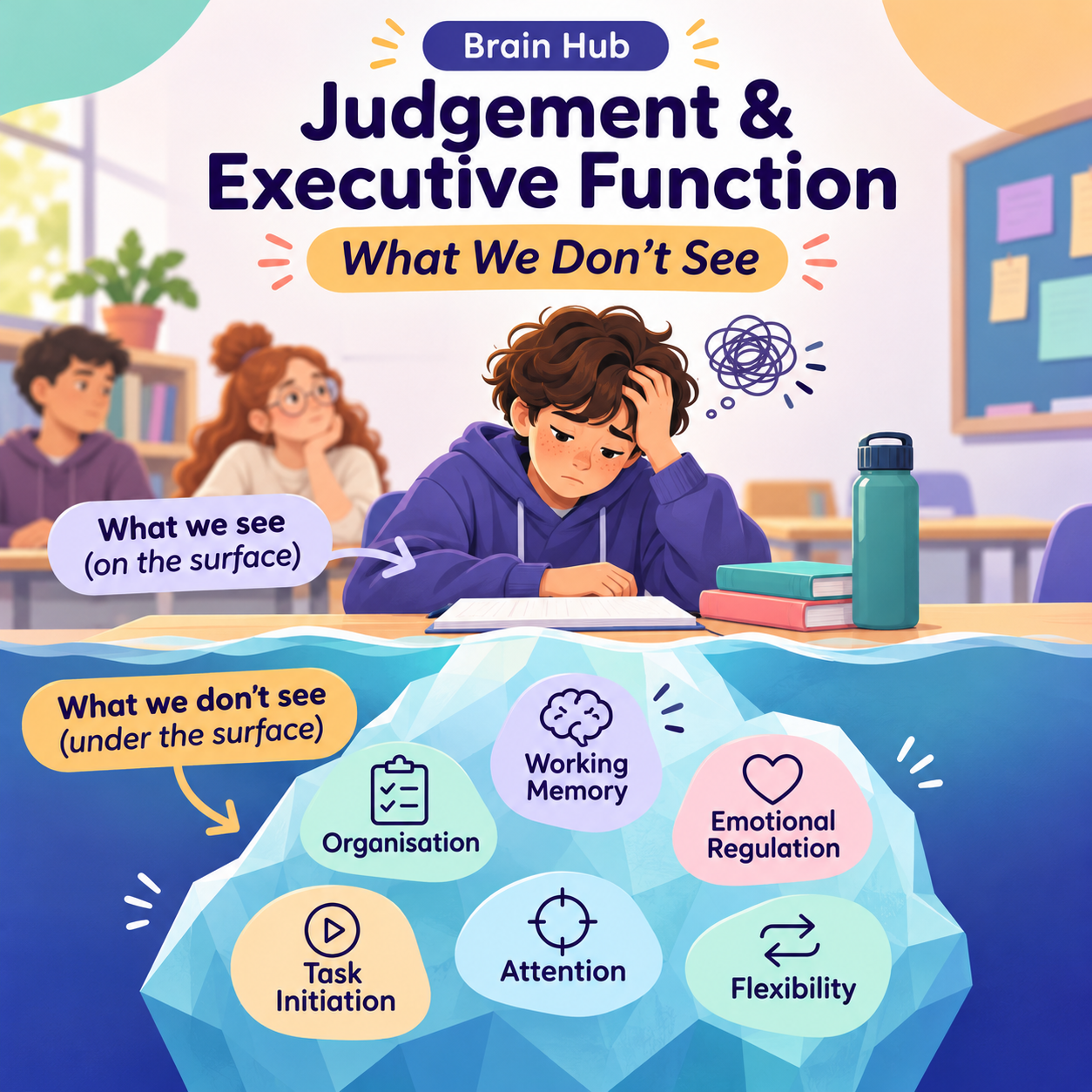
Behaviour is visible. Executive function isn’t.

Executive functions are the mental skills that help us manage ourselves and get things done. At Connections in Mind, we work with eleven core executive function skills: task initiation, response inhibition, flexibility, organisation, goal-directed persistence, metacognition, sustained attention, planning and prioritisation, emotional regulation, working memory and time management.

These skills are involved in almost every part of the school day. A pupil needs working memory to hold onto a multi-step instruction, task initiation to turn “I know what I need to do” into actually beginning, and response inhibition to wait rather than shout out an answer. They need flexibility when the timetable suddenly changes, emotional regulation when something feels unfair or a piece of work becomes frustrating, organisation to keep track of their belongings  and planning to recognise that Thursday’s homework might require them to start thinking about it on Tuesday.

This is part of what makes executive function difficulties so easy to misinterpret. We don’t see the skill itself; we see what happens when a young person struggles to access it.

We don’t see working memory; we see a forgotten instruction. We don’t see task initiation; we see a blank page. We don’t see response inhibition; we hear the interruption. We don’t see flexibility or emotional regulation; we see the reaction when something changes or becomes overwhelming.

When executive function skills are working well, we barely notice them. When they aren’t, we tend to notice the behaviour instead.

Why are we so quick to judge?

There is a psychological reason for this. Judgement is partly a shortcut. Our brains are constantly taking limited information and trying to make sense of it quickly. We categorise, predict and respond, using what we can see alongside our previous experiences, beliefs and expectations.

In a busy classroom, that ability is useful. Educators cannot stop and conduct a detailed analysis every time somebody forgets a pencil or fails to start a task. The difficulty comes when our brain fills in the information we don’t have and an observation quietly becomes an assumption.

“He hasn’t started” becomes “he doesn’t want to work.”

“She interrupted again” becomes “she’s rude.”

“They forgot their PE kit again” becomes “they need to take more responsibility.”

“She became extremely upset over a small change” becomes “she’s being dramatic.”

We have moved from describing what happened to assuming why it happened.

This is particularly relevant to executive function skills because many of the behaviours we are quickest to judge rely heavily on these skills. Starting, remembering, organising, waiting, focusing, switching, planning, managing time and regulating emotions can all look like choices from the outside.

The pupil staring at a blank page may understand the work perfectly but be struggling to identify the first step. The pupil interrupting may be finding response inhibition difficult. Someone who repeatedly loses things may be struggling with organisation, while the pupil who appears not to have listened may have lost part of the instruction from working memory before they had time to act.

Executive function skills do not explain every behaviour, and understanding it does not mean removing expectations or boundaries. It means recognising that before we assume a young person won’t do something, it is worth considering whether they are struggling with the skills required to do it.

Executive function is variable

There is another important part of the picture.

Having an executive function skill does not necessarily mean being able to access it equally well in every situation.

Think about your own brain. Planning a task when you are rested and calm can feel very different from planning the same task when you are exhausted, stressed, distracted or worried about something else. Young people’s brains are no different.

Executive function is affected by what is happening around a young person and within them.

A noisy or visually busy classroom may place additional demands on attention. Multiple verbal instructions may increase the load on working memory. An unexpected timetable change may require significantly more cognitive flexibility. Hunger, tiredness, anxiety or emotional overwhelm can make it harder to regulate, focus, plan or begin.

The social environment matters too. A pupil may be worried about getting something wrong in front of their friends, navigating friendship difficulties, experiencing bullying or peer pressure, or putting enormous effort into fitting in and avoiding judgement.

This helps explain something educators often notice: the same young person can appear to have access to a skill in one situation and struggle significantly with it in another.

A pupil may answer confidently one-to-one but freeze when asked in front of the class. Someone may regulate well in a quiet room but struggle in a noisy corridor. A pupil who copes with change on Monday morning may find a similar change much harder on Friday afternoon after an exhausting week.

That doesn’t necessarily mean they are choosing when to use the skill.

It may mean the conditions in which their brain is being asked to use it have changed.

When “try harder” doesn’t work

Imagine repeatedly struggling with things that everyone around you seems to find easy. You forget what you were asked to do, lose things, start assignments too late or consistently underestimate how long things will take. You promise yourself you’ll concentrate this time, only to realise you haven’t heard the last five minutes, or find yourself overwhelmed by something your friends appear to cope with easily.

Now imagine the message you receive, explicitly or implicitly, is:

“You could do it if you tried harder.”

For a young person, repeated messages like this can gradually become internalised. “I find it difficult to get started” can become “I’m lazy”. “I keep forgetting things” can become “I’m stupid”. “I find this harder than everyone else seems to” can become “There must be something wrong with me.”

That matters because repeated experiences of struggling, being misunderstood or feeling that you are constantly getting things wrong can affect confidence, self-esteem, relationships and a young person’s sense of belonging.

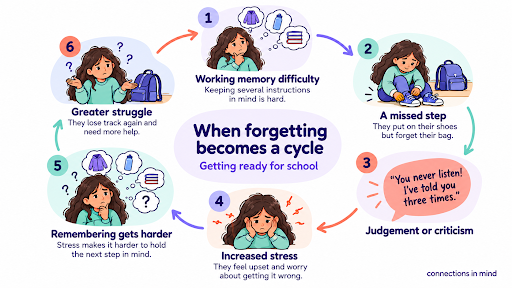
There is also an important connection back to executive function. Stress and overwhelm can themselves make these skills harder to access, potentially creating a difficult cycle:

Executive function difficulty → struggle → judgement or criticism → increased stress → executive function becomes harder to access → greater struggle

What looks from the outside like a pupil “getting worse” may sometimes be a young person becoming increasingly overwhelmed by expectations they are struggling to meet.
Children judge each other too

Adults are not the only people observing and interpreting behaviour. Children and young people are watching each other all the time, and they can make exactly the same leap from what they see to what they believe it means.

The pupil who regularly calls out can become “the annoying one”. Someone who forgets things may be considered careless or stupid. A child who becomes overwhelmed can be labelled “dramatic”, while a pupil who receives movement breaks, additional prompts, more time or a different approach may be perceived as receiving “special treatment”.

Again, what other pupils see is the visible outcome, not necessarily the executive function difference underneath it.

For the young person on the receiving end, these judgements can be deeply isolating. They can also encourage masking: working incredibly hard to hide difficulties, copying other people, avoiding asking for help or suppressing signs of overwhelm because being noticed feels worse than struggling silently.

Creating a neuroinclusive classroom is therefore not only about the adjustments adults make. It is also about the culture we help pupils create around difference and the explanations we give them for why different brains may need different things.

Fair does not always mean the same

One of the most useful ideas we can teach young people is that fairness does not necessarily mean everybody receiving exactly the same thing. Different brains may need different forms of support to access the same opportunities and expectations.

A pupil with working memory difficulties might benefit from instructions being written down. Someone struggling with planning or task initiation may need help breaking a task into manageable steps. A pupil may need movement to support attention, while someone who finds flexibility difficult may benefit from more warning before a transition or unexpected change.

These are not necessarily advantages or an easier route. They are supports for skills that may not yet be reliable.

When difference is understood rather than hidden, we can begin to move away from “Why do they get that?” towards a much more useful understanding: different people may need different things in order to succeed.

From judgement to curiosity: widening the lens

So how do we put this understanding into practice?

When something happens, rather than jumping immediately from behaviour to and assumption, we can widen the lens by asking four questions.

1. What do I actually know?

Start with what you have genuinely observed, without adding an assumption.

“The pupil hasn’t started the task.”

That is an observation.

“They can’t be bothered.”

That is an assumption.

Separating the two helps us recognise where the facts end and our assumptions begin.

2. What have I assumed?

Consider the story you have attached to the behaviour. Have you assumed a lack of effort, motivation, respect or interest? Are you interpreting something as deliberate because you know the pupil has successfully managed it before?

This is particularly important with executive function because performance can vary. Being able to use a skill successfully in one situation does not necessarily mean being able to access it just as easily in another.

3. What executive function skill is this situation asking for?

Now look beneath the behaviour.

Does the pupil need to start, remember, organise, plan, focus, inhibit an impulse, switch, manage time, persist or regulate an emotion?

A pupil may know exactly what is expected of them, but not yet have developed the skills to do it consistently.

4. What else might be affecting their ability to access that skill right now?

This is where we widen the lens further.

What is happening in the environment? Is it noisy, busy, distracting or unpredictable? Are the instructions clear? Has something changed?

What is happening for the young person themselves? Are they stressed, tired, hungry, anxious, frustrated or overwhelmed? What happened before they arrived in this lesson?

And what is happening in their social world? Are they worried about what their peers think? Is there friendship conflict, bullying, peer pressure or a fear of getting something wrong in front of other people?

Rather than asking only “Can this pupil do this?”, we begin to ask a more useful question:

“What is affecting their ability to access this skill right now?”

These questions do not give us an automatic answer. They give us a better place from which to find one.

And then: what do we do?

Curiosity only becomes useful if it changes what happens next.

Once we have a better understanding of what may sit beneath a behaviour, we can decide what kind of response is actually needed.

Sometimes we need to ask the young person. “What part feels difficult?” or “What would help you get started?” may tell us far more than another reminder to begin.

Sometimes we need to adapt the environment by reducing distractions, changing where a pupil sits, making a transition more predictable or reducing unnecessary demands on attention.

Sometimes we need to externalise the executive function with the child, rather than simply doing it for them. Instead of expecting a pupil to hold everything in working memory, we can work together to write the instructions down. Rather than telling them to “get organised”, we can create a checklist with them. Instead of expecting them to work out where to begin, we can identify the first step together.

The aim is not just to make the task easier in that moment, but to help the pupil notice what supports their thinking and gradually build a toolkit they can use more independently over time.

Sometimes we need to teach the skill. Executive function support is not simply about accommodating difficulties. All young people need opportunities to develop strategies for planning, organisation, time management, emotional regulation and other executive function skills. When these strategies are explicitly taught, practised and reinforced as part of whole-class teaching, we support everyone — not just the pupils whose needs are most visible or urgent. It also means that children who need more support are not singled out as somehow different; they are learning and practising the same skills as their peers, within a classroom culture that recognises that everyone’s brain needs strategies and support.

And sometimes the first priority is simply to reduce the load. A young person who is already overwhelmed may need regulation and connection before they can access the executive function skills required for the task.

The response will not be the same for every pupil because the reason will not be the same.

That is precisely why curiosity matters.

Before we assume why

Understanding executive function does not mean explaining away every behaviour, removing boundaries or assuming executive function is always the answer. It means recognising how much we cannot know simply by observing behaviour.

The explanation we choose influences what happens next. If we assume a pupil is lazy, our response may be to push harder. If we recognise that task initiation could be difficult, we might help them identify the first step. If we see carelessness, we might reprimand; if we consider working memory or organisation, we might look at how information and routines are structured.

The expectation does not necessarily have to change. Our understanding of what the pupil may need in order to meet it does.

So before assuming why a behaviour happened, widen the lens:

What do I know?
What have I assumed?
What executive function skill is being required?
What else might be affecting their access to that skill right now?

Then decide what comes next: ask, adapt, support or teach.

Because there is an enormous difference between a young person who won’t do something and one who does not yet have reliable access to the skills they need to do it. From the outside, those two things can sometimes look remarkably similar.

The behaviour is visible. The reasons behind it may not be.

At Connections in Mind, we help educators understand executive function and neurodiversity and translate that understanding into practical approaches that work in real classrooms, helping young people understand their brains, develop the skills they need and have a better chance to show us what they can do.

EXPLORE MORE

Explore the Latest Resources

Continue exploring judgement, behaviour and the executive function skills that can sit beneath what we see.
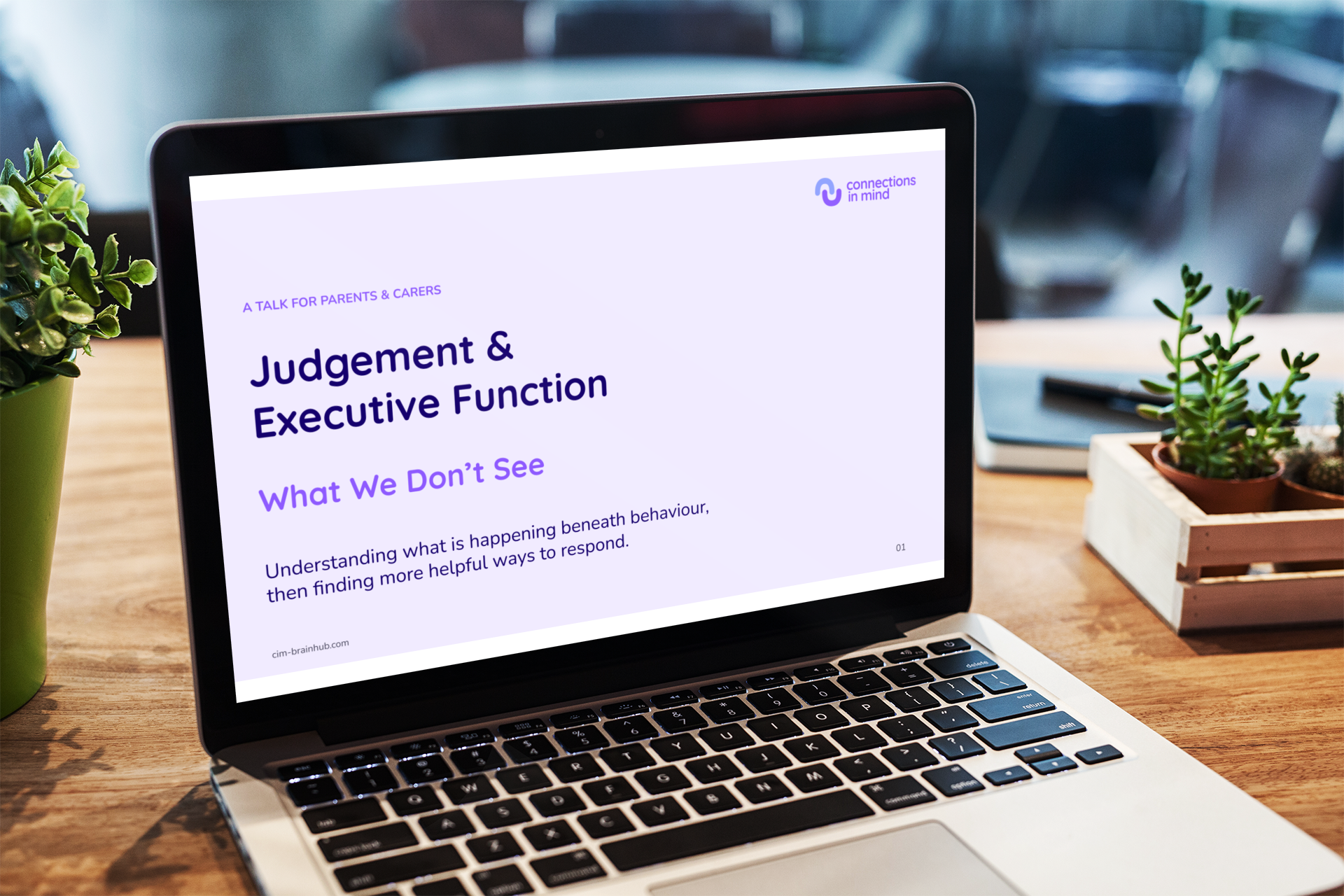
PARENT TALK – Judgement & Executive Function: What We Don’t See
RESOURCE

PARENT TALK – Judgement & Executive Function: What We Don’t See

A ready-to-present talk for parents and carers explaining executive function, the impact of judgement and practical ways to support children at home.

View Resource
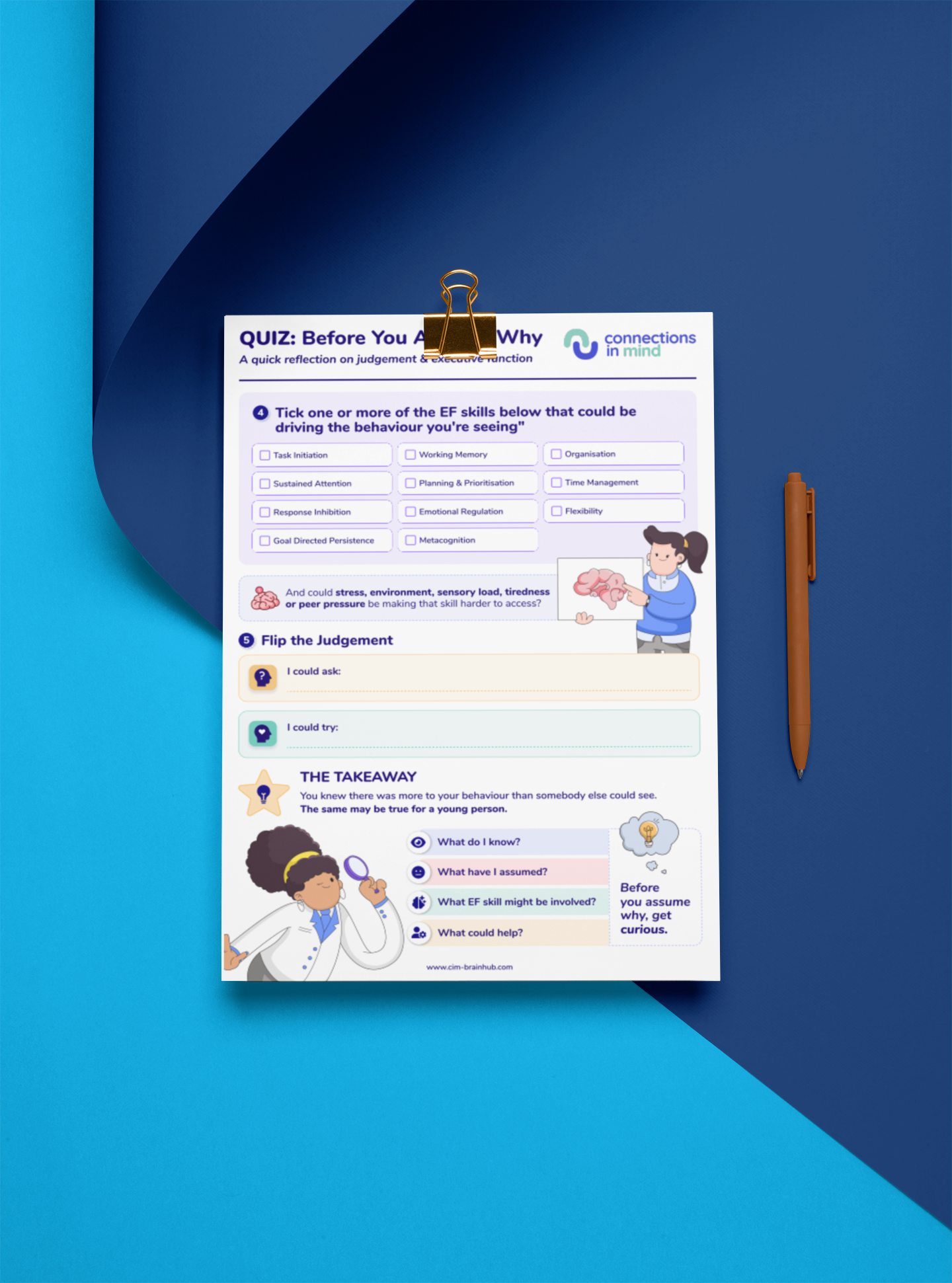
Questionnaire: Before You Assume Why…
RESOURCE

Questionnaire: Before You Assume Why…

A short reflective quiz that helps adults pause before judging behaviour and consider the executive function skills that may be underneath.

View Resource
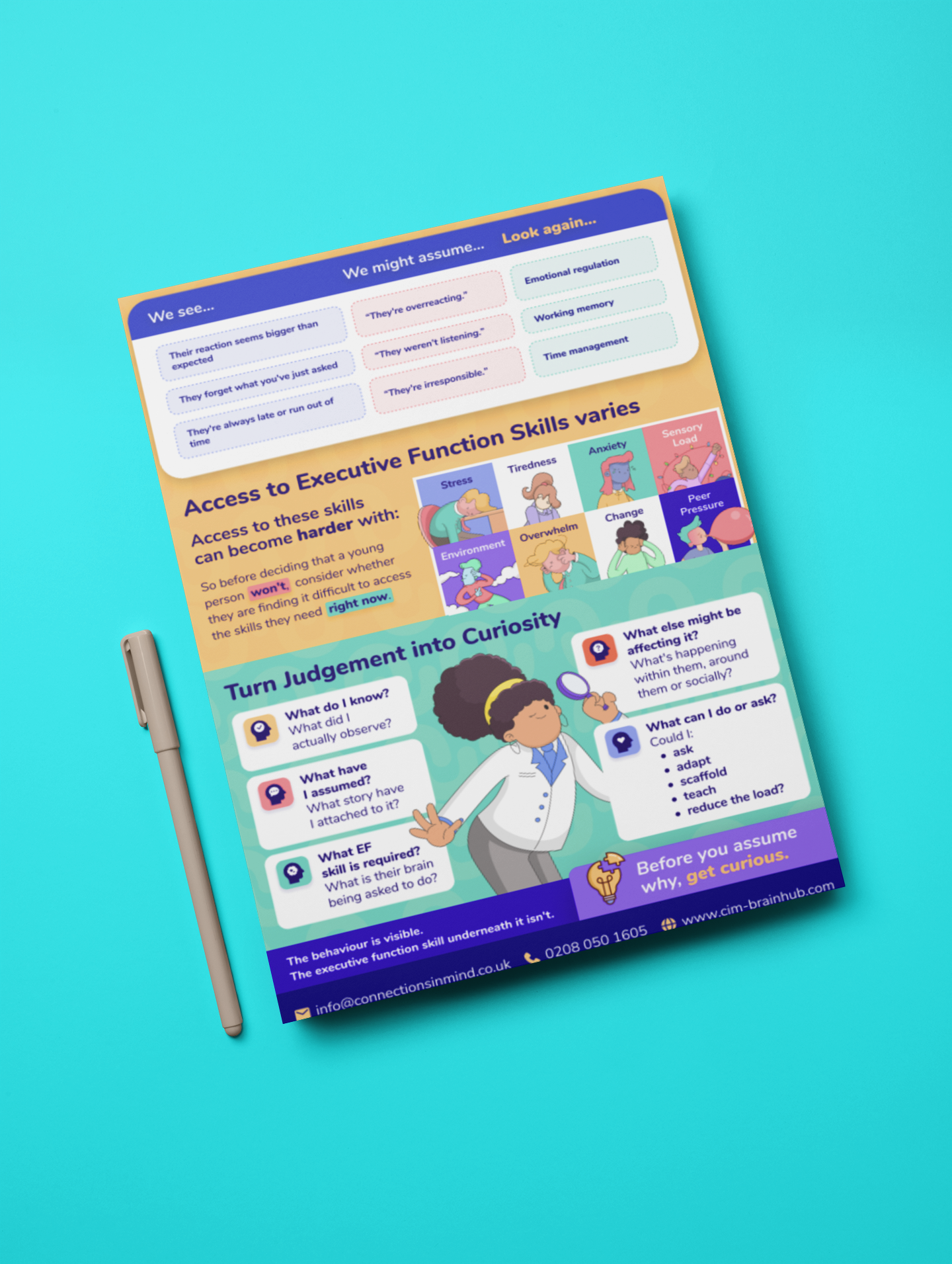
Flyer: Before You Assume Why…
RESOURCE

Flyer: Before You Assume Why…

Before you assume why, get curious. A flyer linking 11 common behaviours to the lagging executive function skills that may sit underneath.

View Resource
VIDEO – Before You Assume Why…
RESOURCE

VIDEO – Before You Assume Why…

A one-minute animated video showing how judgement hides executive function difficulties, and why curiosity should come before assumption.

View Resource

Leave a Comment

View Basket 0 items 0
Scroll to Top